Southern Utah Wilderness Alliance

A tireless advocate for Utah wilderness

10:39 am

Yesterday, longtime redrock champion Representative Maurice Hinchey (D-NY) announced he will not seek re-election.  At SUWA, we are saddened at the loss of this fierce and dedicated environmental hero.  Our relationship with Maurice began nineteen years ago when he accepted former Utah Representative Wayne Owens’ request that he become the lead sponsor for America’s Red Rock Wilderness Act.
Hinchey with activists
Maurice Hinchey (3rd from left) with
redrock activists George Handley,
McKenzie Carlise, and Eve Miller before
a House Natural Resources Committee
hearing on America’s Red Rock
Wilderness Act in October 2009.

Maurice has been a tireless advocate for protecting Utah wilderness – engaging (and winning) in legislative battles, prodding the BLM to do better from his perch on the Appropriations committee and moving the Red Rock bill forward by gathering cosponsors for the legislation and holding hearings.

Maurice and his staff visited the country he sought to protect numerous times.  One memorable occasion was in 1995 when citizens held field hearings in both Salt Lake City and Cedar City to shed light on the Utah Congressional delegation’s legislative attack on wilderness.  When Maurice stepped off the plane in SLC at midnight, a crowd of Utahns roared approval.  He looked over his shoulder to see who the fuss was for — only to realize we were all waiting for him.

In Cedar City he spoke at the hearing to a cheering crowd of Utah supporters (to the chagrin of Utah Representative Jim Hansen).  We were thankful that someone in Congress would listen to us and understood the importance of wilderness to Utahns and the rest of the nation.

We will miss Maurice’s dedication and experience on the issue.  But with 117 cosponsors in the House of Representatives and Senate champions like Sen. Dick Durbin of Illinois, we’ll continue to make progress towards protecting Utah’s redrock wilderness.

Please join me in thanking Congressman Hinchey for his decades of work on behalf of Utah’s redrock wilderness by writing a note on his Facebook page, tweeting thanks to @mauricehinchey or writing a letter to his DC office at:

Representative Maurice Hinchey
2431 Rayburn House Office Building
U.S. House of Representatives
Washington, DC 20515

Full of worms: APPLE is the definition of a “land grab”

1:28 pm

Starting hearings with historical tidbits is a hobby of former history teacher Rep. Rob Bishop. Often, it’s charming. But in this morning’s hearing on his own APPLE bill, which allows Western states to seize federal lands to fund schools, it proved also to be illuminating.

Apparently, Bishop’s H.R. 2852 takes cues from the murderous, tyrannical King Henry VIII.

“Henry the VIII took holdings of the Catholic Church and gave it to the aristocracy on the condition that they maintain the schools established by the church,” Bishop said in defense of his bill in his opening statement.

And “took” is clearly the operative word. Henry VIII confiscated assets, gave them to his friends, and did so, in Mr. Bishop’s reading of history, for the schoolchildren. For a guy with six wives—four with heads—it was par for the course. For modern school policy? Let’s do better.

The APPLE bill allows states to “claim” five percent of the “unallocated” federal lands in their jurisdiction to increase the tax base for schools. Unallocated means anything not already designated a national park, wilderness, wilderness study area, national monument, etc.—any BLM or Forest Service land not in protected status, which, in Utah, is most of it. Saturday is National Public Lands Day—a great opportunity to head out to enjoy a hike or a picnic on your federal lands, and look around at where you are. It’s likely most of your weekend enjoyment will be brought to you by such “unallocated” lands.

At a time when all eyes are on the federal deficit, the APPLE bill takes somewhere between 24 and 30 million acres and billions of dollars of federal assets and—poof!— simply gives them away. Harris Sherman, undersecretary of the Department of Agriculture, testified against the bill this morning, saying it would polarize stakeholders, transfer national assets to states and counties, diminish multiple uses and recreation and “complicate rather than improve the federal deficit problem.”

Bishop claims this is necessary because the U.S. promised Utah at statehood that the federal land would be eventually sold. That’s both a misinterpretation of Utah’s founding documents, and a tired old talking point—especially for a history buff.

David Alberswerth of the Wilderness Society testified that by that logic, “…any Member of Congress from the State of Utah who sponsors this legislation is breaking Utah’s ‘solemn compact’ with the United States of America…because Utah’s enabling statute states that, ‘… the people inhabiting said proposed State do agree and declare that they forever disclaim all right and title to the unappropriated public lands lying within the boundaries thereof…’”

Forever’s a long time. We’re not there yet.

Fortunately, there are proven ways to improve the straits for our schools. But because federal lands are not the problem, giving away federal lands is not the answer. As this excellent letter to the editor pointed out, one of the best means of gaining revenue from the State lands already set aside to fund schools in Utah (which comprise over 10 percent of Utah’s land base) is to consolidate them through land swaps, furthering both conservation and development.

Combining the diaspora of state lands that languish in remote, hard to access places would gain thousands of acres of developable land for the state, thousands of acres of wild land for future Americans to enjoy and thousands of dollars of new revenue for Utah’s school kids. I may be a K-through-college product of Utah schools, but that’s what I call smart thinking.

Utah Wilderness News, May 12, 2011

1:03 pm

Sen. Durbin and Rep. Hinchey Reintroduce America’s Redrock Wilderness Act
Measure is endorsed by the Sierra Club, the Wilderness Society, the Natural Resources Defense Council, the Southern Utah Wilderness Alliance in Utah, and more than 240 local and national conservation groups with the Utah Wilderness Coalition

“In an effort to preserve 9.1 million acres of Utah’s spectacular red rock country as wilderness, U.S. Senator Dick Durbin (D-IL) and Congressman Maurice Hinchey (D-NY) today introduced legislation in the Senate and House that would ensure the public land remains in its natural, undeveloped state. Durbin and Hinchey’s bipartisan America’s Red Rock Wilderness Act, which was introduced with 66 cosponsors in the House and three in the Senate, would protect the land from commercial development, motorized vehicles, road building, as well as oil and gas drilling. Currently, the U.S. Bureau of Land Management (BLM) owns the 9.1 million acres, but the agency is not prohibited from selling part of the land for development or developing parts itself.

“The legislation Congressman Hinchey and I are introducing today will designate as wilderness some of our nation’s most remarkable, but currently unprotected public lands,” said Durbin. “This land was chosen based on meticulous research and surveying of thousands of square miles to determine which lands should be protected. America’s Red Rock Wilderness is a lasting gift to the American public that will give future generations the opportunity to enjoy a landscape that so many now cherish.”

“America’s red rock wilderness is a national treasure that must be preserved in its natural state for future generations to enjoy and cherish,” said Hinchey. “Since former Congressman Wayne Owens introduced this bill 20 years ago, support has continued to grow as more and more Americans have learned of the need to protect this region’s natural beauty. Conservation groups from throughout the country and in Utah support this effort, and I am hopeful that this legislation will one day become law.”

Read the rest of the press release.

Last chance to ask your Congress members to be original redrock bill cosponsors

10:57 am

In a few days, Representative Maurice Hinchey (D-NY) and Senator Dick Durbin (D-IL) will reintroduce America’s Red Rock Wilderness Act in the 112th Congress.

Please ask your members of Congress TODAY to sign on as original cosponsors of this legislation, which would protect over 9 million acres of spectacular wilderness in Utah.

Having a large number of original cosponsors — those members of Congress who have signed on to the bill prior to introduction — will help showcase the widespread support across the country for protecting Utah wilderness, and will create a broad line of defense against anti-wilderness attacks in Congress that are occurring already this year.

Thank you for taking action!

Activists (Red)Rock Congress

9:19 am

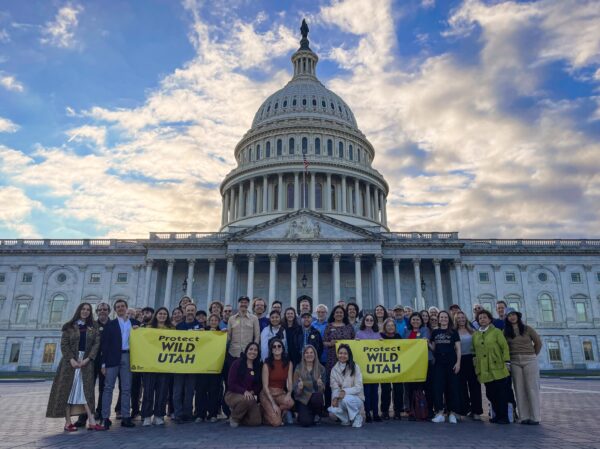
The redrock is particularly lucky to have a large number of articulate and passionate activists dedicated to achieving lasting protections for Utah wilderness.  Last week, 20 of those folks (half from Utah and half from across the country) traveled to Washington, DC for Utah Wilderness Week 2011 to ask their members of Congress to support protecting America’s redrock wilderness and to defend against anti-wilderness attacks in Congress.


The mission: Convincing Senators and Representatives to cosponsor America’s Red Rock Wilderness Act in the 112th Congress, and also to ask them to preserve administrative tools (the “Wild Lands” policy and the Antiquities Act) that could be used by the Obama administration to protect special places in southern Utah.  After a full day of lobby training and learning about the issues in more detail, the activists were ready to take on Capitol Hill, proudly displaying their bright yellow and black “Protect Wild Utah” buttons.

Some of the highlights of the week:

Maryland activist Claire Gardner (pictured 2nd from left) met with her Representative Chris Van Activists with Van HollenHollen (D-MD, pictured 2nd from right), who did not cosponsor America’s Red Rock Wilderness Act last Congress after supporting the bill in the  past.  Not only was she and her teammate John Hoener (UT, pictured first on right) able to meet with the Congressman himself, but emerged from the meeting with a promise to cosponsor the bill.  Rep. Van Hollen followed up on his word and was one of the first Representatives to cosponsor America’s Red Rock Wilderness Act in the 112th Congress.

The Utahns were able to meet with 3 members of their delegation personally: Rep. Jason Chaffetz UWC group with Lee (R-UT), Rep. Jim Matheson (D-UT), and Sen. Mike Lee (R-UT, pictured 4th from left).  Although the Utah delegation does not often see eye to eye with Utah wilderness supporters, the meetings were productive and reminded these members of Congress that Utahns do support protecting the remaining wild lands in their state.

The activists were also able to attend a House Natural Resources Committee oversight hearing on the Bureau of Land Management’s “Wild Lands” policy.  While it was disappointing to see how wilderness foes on the committee had stacked the deck of witnesses against the policy, everyone was excited to display their yellow “Protect Wild Utah” buttons and listen to wilderness champions on the committee such as Reps. Martin Heinrich (D-NM), Raul Grijalva (D-AZ), Ed Markey (D-MA), John Garamendi (D-CA), and Rush Holt (D-NJ) defend the BLM’s authority to manage lands for their wilderness characteristics.

Overall, the week was very successful and we already have a list of Congress members who have officially signed on as cosponsors of America’s Red Rock Wilderness Act.  Thank you to all who participated!

You can see more photos from the week on SUWA’s Flickr page, and read about the event from an activist’s perspective on participant Carolyn Jackson’s (NYC/Bluff, UT) blog.

How can you help?

1) Call the Capitol Switchboard at 202-224-3121 and speak with your Senators’ or Reprensentative’s DC offices, asking that they cosponsor America’s Red Rock Wilderness Act.

2) Go to our Action Center and send emails to your members of Congress, asking that they cosponsor America’s Red Rock Wilderness Act.

3) Sign the petition asking Congress to protect America’s Redrock Wilderness:

Petitions by Change.org|Start a Petition »