Southern Utah Wilderness Alliance

Take a protect Greater Canyonlands photo! Daryl Hannah and Neil Young did.

11:25 am

Actress/director Daryl Hannah and rock legend Neil Young were in Moab last Friday and showed their support for protecting Greater Canyonlands!

Neil later wrote (https://www.facebook.com/lincvolt):

“Imagine the beautiful majestic canyons and valleys of Canyonlands National Park, the same legendary landscape immortalized around the world in car commercials and posters of American beauty, and you know where we are now. Imagine a nightmare where these lands are raped by Big Oil and the American Government, working hand in hand to create another tar sands disaster for Planet Earth in our sacred Canyonlands National Park. The plans are made and the forces are moving.
Ignoring the Climate Chaos that has become the new normal, ignoring the inefficiency of tar sands oil production, ignoring the species becoming extinct as you read this, ignoring a chance for a clean tomorrow, these forces of reckless greed are moving forward and if you don’t do something about it and get active, raise awareness, make your own statements, then it will be partly your responsibility. The destruction will rest on your shoulders. Get active. Make change now. Fight for Freedom to choose the fuel you use. End fossil fuel abuse. End carbon waste. Begin now.”

Join them by taking a Protect Greater Canyonlands photo! Click here for more info: http://bit.ly/GCCampaign

Clean Energy Now! Rally on Thursday, Jan. 10

11:39 am

From our friends at HEAL Utah:

Thursday, January 10, 2013

12:30pm MST

Salt Palace Convention Center
100 S West Temple, Salt Lake City, Utah 84101


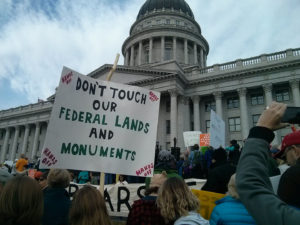
Please join us as we rally outside of Governor Herbert’s Energy Summit to demand that our elected officials invest in Utah’s bountiful supply of renewable energy. Inside the summit, lobbyists and state officials will be plotting how they can exploit dangerous resources like tar sands, oil shale and nuclear power — even though those will drain our precious water, destroy wildlife, spoil our fragile wilderness, pollute our air and contribute to the ongoing warming of our planet. Hundreds of Utahns will gather to protest the Governor’s 19th Century dirty energy policies, highlighting how Utah is falling behind other states and countries which are making solar, wind, and geothermal resources affordable and available right now. Bring your friends, family and neighbors to help send a message to our state leaders. Utahns deserve a clean energy future! Now! One voice! One message!

RSVP and invite friends on Facebook by clicking here.

U.S. Fish and Wildlife Service Proposes Listing Imperiled Tiger Beetle for Protection

2:38 pm

Strikingly Marked Coral Pink Sand Dunes Tiger Beetle Threatened by Off-Road Vehicles, Drought, Climate Change

For immediate release: October 1, 2012

Contact:
Taylor Jones, WildEarth Guardians: (303) 353-1490 or tjones@wildearthguardians.org
Heidi McIntosh, Southern Utah Wilderness Alliance: (801) 428-3980 or heidi@suwa.org

Washington, DC – The U.S. Fish and Wildlife Service (Service) announced today that it will propose to list the Coral Pink Sand Dunes tiger beetle as “threatened” under the Endangered Species Act (ESA) and to designate 2,276 acres of critical habitat for the species. The tiger beetle has been a candidate for listing for nearly 30 years.  The Service identified off-road vehicle (ORV) use, climate change, and drought as primary threats to the species.

Cicindela albissima—The Coral Pink Sand Dunes Tiger Beetle. Photo copyright Beetles in the Bush (http://beetlesinthebush.wordpress.com/).


“We commend the Service for recognizing and acting on the continuing threats to this rare insect,” said Taylor Jones, Endangered Species Advocate for WildEarth Guardians. “This gorgeous, fierce little creature is found in only one place on earth, and it deserves our respect and needs our protection.”

A portion of the tiger beetles’ habitat is located in a wilderness study area that the Bureau of Land Management (BLM) is required by law to protect, yet the agency has refused to halt damaging ORV use which puts the species at risk. Heidi McIntosh, associate director of the Southern Utah Wilderness Alliance, said, “This important listing could at long last put an end to destructive ORV use in one of the most beautiful and unique landscapes in the state. BLM’s stubborn refusal to protect this remarkable species and its habitat made this listing proposal inevitable.”

The dunes the Coral Pink Sand Dunes Tiger Beetle inhabits cover 3,500 acres, of which 2,000 acres is within Coral Pink Sand Dunes (CPSD) State Park in Utah. The remaining 1,500 acres are on adjacent Bureau of Land Management land partly within the Moquith Mountain Wilderness Study Area. The tiger beetle occurs consistently in only two populations, which occupy a total area of only about 500 acres. The northern population may not be self-sustaining, instead relying on dispersal from the central population.

Although core areas of tiger beetle habitat have been closed to ORVs since 1997 (207 acres within CPSD State Park and 370 acres on BLM land), ORV use still occurs in 52 percent of occupied CPSD tiger beetle habitat in the central population in the State Park, as well as in the dispersal corridor between the two populations. For the small northern population, enforcement of protections on BLM land is minimal and relies mainly on voluntary compliance. ORVs, aside from crushing beetle larvae and adults, can damage vegetation, reducing the beetle’s prey base and drying out their habitats even further. During years when their population is small, the beetles concentrate in the protected area in CPSD State Park. In years when beetle numbers are exceptionally high, a greater percentage of them are found outside the conservation areas where they are vulnerable to harm from ORVs.

ORV use has a history of reducing or eliminating tiger beetle populations; victims have included Northeastern Beach tiger beetle populations in several locations, a portion of the White Beach tiger beetle population in Maryland, and the hairy-necked tiger beetle, Siuslaw hairy-necked tiger beetle, and St. Anthony Dune tiger beetle populations in California, Oregon, Washington, and Idaho.

Drought is also a major threat to the Coral Pink Sand Dunes tiger beetle; rainfall is one of the primary factors controlling the beetle’s population size, which tends to fluctuate dramatically from year to year. Drought sucks the moisture from the soil, reducing the size of the beetle’s already limited habitat as well as reducing the populations of their prey insects.  Climate change may exacerbate the impacts of drought in years to come.

The Service has proposed to designate 2,276 acres of dunes in CPSD State Park (767 ac) and on BLM land (1,508 ac) as critical habitat for the beetle. Species with designated critical habitat are twice as likely to recover as those without critical habitat.

The tiger beetle was petitioned for listing by the Southern Utah Wilderness Alliance in 1994. It is one of 252 candidate species covered in WildEarth Guardians’ settlement agreement with the Service, announced on May 10, 2011, and approved by a federal court on September 9, 2011. The agreement obligates the agency to either list or find “not warranted” for protection all 252 candidates by September 2016.

Moquith Mountain Wilderness Study Area. Photo copyright Ray Bloxham/SUWA.

Patagonia catalog highlights dust impacts to Colorado snowpack

12:25 pm

In the Winter 2011 Patagonia catalog, Amy Irvine McHarg writes:

The sky is falling. Particle by red, raw particle. And it’s falling on some of the world’s best snow.

Dust from the deserts of the American Southwest – Mojave, Sonoran, Great Basin and Chihuahuan – is getting scooped up in spring gales charging fresh off the Pacific. The airborne grit gets hurled across the western states before it is plastered onto the gleaming white snowfields of southwest Colorado’s San Juan Mountains. Home to the sweet and steep slopes of Telluride. To the frozen, front-pointable waterfalls of Ouray. To bluegrass fests, meadows of mushrooms, cannabis cafés and robust herds of elk. The effect is dizzying. Because these mountains, a rugged and rarified range where 14,000-foot, incisor-like peaks gnaw at an endless, crystalline sky, loom so large. On the horizon. In the psyche. To see iconic monoliths like the San Juans in such an altered state of color is sort of like having seen Marilyn Monroe after she had dipped her head in a bowl of henna…

…But there’s more to this story than the fate of one’s skis. Like asphalt on a hot summer’s day, the darkened snowfields absorb rather than reflect the sun’s rays. This means that a single dust storm can melt the snowpack weeks ahead of schedule. Down below, in the flatlands, the runoff runs so high and fast that there’s no way to store it. By midsummer, reservoirs get tapped hard. Crops, wildlands and lawns are left wanting. An annual loss like this can total over 35 billion cubic feet – water that would supply Denver for three years.

That’s a lot of snowflakes. And in terms of its effect, what happens in Colorado definitely does not stay in Colorado. When San Juan snowflakes melt, they trickle their way into important rivers: The San Miguel, known for its angling holes full of wily native trout. The Dolores, where bighorn sheep have successfully been restored to narrow sandstone cliff bands above the water. And the San Juan, which borders Navajo Lands and harbors on its shores some of the world’s densest clusters of prehistoric art and ruins. All three rivers eventually merge with the Colorado River, one of the West’s most vital waterways, which provides power and water for Wyoming, Colorado, Utah, New Mexico, Nevada, Arizona and California. About 30 million people (and counting) rely on this watershed alone. Of the 5 trillion gallons the river provides, those western states manage to use every drop, which means they cannot afford to miss even one bucket full of San Juan runoff.

Click here to read the full essay.

Visit our website to learn more about the red dust on snow issue and take action.

Utah Wilderness News, May 17, 2011

12:35 pm

Study: Climate change has significant impact on Southwest soil

“The study found, for instance, that biological soil crusts held up well against climate shifts. Data collected in the national parks, where the land is largely protected from vehicles, livestock and other disturbances, suggest that vulnerable areas outside the parks can also be managed to minimize soil impacts. Lisa Bryant, a soil scientist for the U.S. Bureau of Land Management in Utah, said information like the climate-dust study helps her agency formulate its plans for the 22.9 million acres under its jurisdiction in Utah.” Read more – The Salt Lake Tribune

Wild Lands Policy continues to be misunderstood, debated

“It’s no secret that large swaths of BLM land are already earmarked for energy extraction. In the West’s five biggest oil and gas producing states (Colorado, Montana, New Mexico, Utah and Wyoming), 42 percent of BLM land is already leased to the industry. And if the areas that would receive extra scrutiny under Salazar’s order aren’t, as their critics maintain, the most obvious candidates for wilderness protection, neither are they troves of fossil fuel. ‘Most of them are not candidates for oil and gas development, and probably never will be,’ says John Leshy, the top Interior solicitor under President Clinton. ‘The vast majority of lands that have attraction to the industry are available to them.’” Read more – High Country News